Md Rizwan Parvez

I am a Scientist at Qatar Computing Research Institute (QCRI), Hamad Bin Khalifa University, where I lead research on auditable language and coding agents. Before that, I was a Research Scientist at Bosch Research. I received my Ph.D. in Computer Science from the University of California, Los Angeles, where I worked with Prof. Kai-Wei Chang, and interned at Google Research, Meta FAIR, Salesforce Research, and Microsoft. My research focuses on natural language processing, machine learning, and software engineering, with the goal of building agents whose claims, code, and actions can be checked against evidence, execution, and the environment they act in, rather than taken on the model’s word. Currently, my research covers three kinds of agents: (1) knowledge agents that retrieve, remember, and attribute evidence, (2) coding agents for software engineering whose output is verified by execution, and (3) grounded and live agents that act on maps, the web, GUIs, and charts, together with (4) the safety, security, and trust of these agents.

I am actively looking for research interns, and I co-supervise Ph.D. students with university partners. Please note that I currently do not have funding for paid positions, so internships are unpaid research assistantships. If you are interested in AI agents, code generation and software engineering, or retrieval-augmented generation, please check the recruiting information here.

News

Research

Large language models have made natural language an interface to computation, yet they fail in ways users cannot easily detect: answers cite unsupported sources, generated code runs but returns wrong results, and agents act on outdated views of their environment. My guiding principle is to never let the model be its own only witness. An answer should be checked against its cited passages, a program against its specification and execution, and an action against observations of the environment it will change. My research builds these checks throughout an agent’s workflow, along three connected threads.

Auditable agents: four connected threads
Safety, Security, and Trust of Agents Trustworthy · Guardrails · across all three Can the agent be trusted?

Knowledge AgentsAttributed · Memory

What does the agent know and remember?

Attribution is a pipeline property, not a post-hoc citation. Provenance survives to the output only if valuation, retrieval, filtering, and generation each expose an auditable decision. Open-RAG turns an open LLM into a sparse mixture-of-experts that ignores distractors and decides when to retrieve; its Llama2-7B version outperforms ChatGPT-RAG and Self-RAG. FiLCo learns which context to keep, DelucionQA detects hallucination, and CoT-PoT reaches self-consistency from two samples. Xolver extends retrieval to agentic memory: past solutions, experiences, and skills become one evolving store the agent can retrieve from as it works. The same machinery runs in legal aid (Mina), cyber-threat intelligence (TechniqueRAG), and medical screening (DR-VQA).

Source data valuation
Source valuation, Budgeted selection, VideoLights
Retrieval and filtering
RedCoder, FiLCo, ERA, DelucionQA, Open-RAG
Retrieval-augmented reasoning
Open-RAG, Chain of Evidences, CoT-PoT
Attribution and audit
DelucionQA, Conformal Lens
Agentic memory and skills
Xolver
Applied domains
TechniqueRAG, Mina, DR-VQA

Coding AgentsVerifiable · Tools and execution

What does the agent produce?

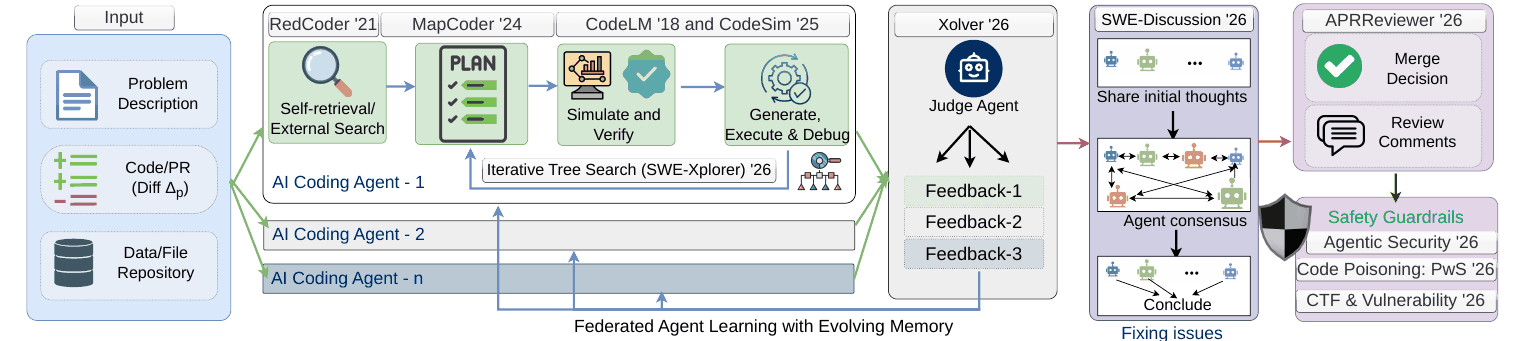
The bottleneck is correctness, not fluency. Code can be executed and tested, so it is where agent outputs can be verified. RedCoder was among the first retrieval-augmented code generators; MapCoder extended it to a recall–plan–code–debug team of agents, and CodeSim verifies plans by simulation before code exists (95.1% on HumanEval). Xolver carries this to general problem solving with shared, evolving memory, and xCodeEval evaluates code by execution at scale. At repository scale, SWE-Xplorer reconciles parallel search paths (53.2% to 60.8% on SWE-Bench Verified), and our agents resolve issues through discussion and review real pull requests.

Experience and skill memory
RedCoder, MapCoder, Xolver
Foundation models for code
Text and Code LM, RedCoder, PwS
AI coding agents
MapCoder, CodeSim, Xolver
Software engineering agents
SWE-Xplorer, SWE-Discussion
Evaluation and judge agents
xCodeEval, VibeSweBench, PR Reviewer
End-to-end code pipeline (figure from my research statement)Language-to-code pipeline: federated coding agents retrieve, plan, simulate and verify, and execute and debug; a judge agent reconciles feedback into evolving memory; discussion and reviewer agents resolve issues behind safety guardrails.

Grounded and Live AgentsGrounded · Environment

How does the agent act?

Instrument first, then build the agent. On maps, the web, GUIs, and charts, models recite state they cannot operate on. MapEval exposed a gap of more than 20 points to humans in geo-spatial reasoning and grew into MapAgent, SpatiaLab, and TimeSpot. WebOperator searches web actions while ranking them by reversibility, GUI-Primitives isolates screen grounding as the bottleneck for computer-use agents, AgentTell shows that browser-use agents leak information through behavioural side channels, and ChartQAPro and DashboardQA test agents on the charts and dashboards organizations reason with.

Tool-calling agents
MapQaTor, MapEval, MapAgent
Spatio-temporal grounding
SpatiaLab, TimeSpot, UrbanAgentBench
Visual data agents
ChartInstruct, DataNarrative, ChartQAPro, ChartQA-Video, ChartOrchestra
Web and computer-use agents
WebOperator, GUI-Primitives, AgentTell, DashboardQA

Safety, Security, and Trust of AgentsTrustworthy · Guardrails · across all three

Can the agent be trusted?

Trust has to be built in, then audited. Our critical review of LLM evaluation diagnoses why model comparisons mislead. X-Teaming red-teams multi-turn conversations with collaborating planner, attacker, and verifier agents; Poison with Style shows the code supply chain can be poisoned with almost no utility loss; AI Debate helps human judges assess disputed claims; and our agentic security survey and AgentTell map threats to agents, including behavioural side-channel leakage in browser-use agents.

Evaluation
LLM evaluation review
Red-teaming
X-Teaming
Code poisoning
PwS
Security of agents
CTF failure attribution, Agentic Security, AgentTell
Oversight
AI Debate

Where this is heading

  1. A unified, attributed, and safety-certified knowledge substrate for everything an agent consumes, from documents and memory to skills and tools.
  2. A research platform for trustworthy human–AI software engineering across the full development lifecycle.
  3. Agents that stay grounded as the physical and digital world changes under them.

More on the research page and in my research statement (PDF).

Selected Publications

Highlights: 45+ peer-reviewed papers 2,700+ citations h-index 19 i10-index 26

Published at ACL, EMNLP, NAACL, EACL, COLM, TMLR, ICML, NeurIPS, and ICLR. Citation metrics from Google Scholar, as of October 2026. Full list on the publications page.

Knowledge Agents

  1. Under review
    Md Tanzib Hosain, Salman Rahman, Md Kishor Morol, and Md Rizwan Parvez
    Top-performing results on 14 reasoning, math, coding, and agentic tasks, including AIME, LiveCodeBench, GPQA, HLE, BrowseComp, GAIA, OS-World, and SWE-Bench Verified
    @misc{hosain20254xolver,
      title = {{Xolver: Multi-Agent Generalist Problem Solving with Holistic Experience Learning}},
      author = {Hosain, Md Tanzib and Rahman, Salman and Morol, Md Kishor and Parvez, Md Rizwan},
      howpublished = {AI4Math Workshop at ICML 2026; under review},
      year = {2026}
    }
    
    Details
  1. EMNLP Findings ’24
    Shayekh Bin Islam, Md Asib Rahman, K S M Tozammel Hossain, Enamul Hoque, Shafiq Joty, and Md Rizwan Parvez
    Press coverage: MarkTechPost
    @inproceedings{shayekh2024openrag,
      title = {{Open-RAG: Enhanced Retrieval Augmented Reasoning with Open-Source Large Language Models}},
      author = {Islam, Shayekh Bin and Rahman, Md Asib and Hossain, K S M Tozammel and Hoque, Enamul and Joty, Shafiq and Parvez, Md Rizwan},
      booktitle = {Findings of EMNLP 2024},
      year = {2024}
    }
    
    Details
  2. Preprint
    Zhiruo Wang, Jun Araki, Zhengbao Jiang, Md Rizwan Parvez, and Graham Neubig
    Listed among AI-Guides’ most impactful RAG papers
    @misc{Wang2023filco,
      title = {{Learning to Filter Context for Retrieval-Augmented Generation}},
      author = {Wang, Zhiruo and Araki, Jun and Jiang, Zhengbao and Parvez, Md Rizwan and Neubig, Graham},
      howpublished = {Pre-print},
      year = {2023}
    }
    
    Details
  3. EACL ’23
    Md Rizwan Parvez, Jianfeng Chi, Wasi Uddin Ahmad, Yuan Tian, and Kai-Wei Chang
    @inproceedings{parvez2022ret-privacy,
      title = {{Retrieval-Enhanced Data Augmentation for Question Answering on Privacy Policies}},
      author = {Parvez, Md Rizwan and Chi, Jianfeng and Ahmad, Wasi Uddin and Tian, Yuan and Chang, Kai-Wei},
      booktitle = {EACL 2023},
      year = {2023}
    }
    
    Details

Coding Agents

  1. Under review
    SWE-Xplorer: Iterative Tree Search with Cross-Path Reconciliation for Autonomous Software Engineering
    Mahir Labib Dihan, Tanzima Hashem, Mohammed Eunus Ali, and Md Rizwan Parvez
    @misc{dihan2026swexplorer,
      title = {{SWE-Xplorer: Iterative Tree Search with Cross-Path Reconciliation for Autonomous Software Engineering}},
      author = {Dihan, Mahir Labib and Hashem, Tanzima and Ali, Mohammed Eunus and Parvez, Md Rizwan},
      howpublished = {Under review},
      year = {2026}
    }
    
    Details
  2. Under review
    Md Tanzib Hosain, Salman Rahman, Md Kishor Morol, and Md Rizwan Parvez
    Top-performing results on 14 reasoning, math, coding, and agentic tasks, including AIME, LiveCodeBench, GPQA, HLE, BrowseComp, GAIA, OS-World, and SWE-Bench Verified
    @misc{hosain20254xolver,
      title = {{Xolver: Multi-Agent Generalist Problem Solving with Holistic Experience Learning}},
      author = {Hosain, Md Tanzib and Rahman, Salman and Morol, Md Kishor and Parvez, Md Rizwan},
      howpublished = {AI4Math Workshop at ICML 2026; under review},
      year = {2026}
    }
    
    Details
  3. NAACL Findings ’25
    Md Ashraful Islam, Mohammed Eunus Ali, and Md Rizwan Parvez
    Second-best coding agent on HumanEval (Feb 2025)
    @inproceedings{islam2025codesim,
      title = {{CodeSim: Multi-Agent Code Generation and Problem Solving through Simulation-Driven Planning and Debugging}},
      author = {Islam, Md Ashraful and Ali, Mohammed Eunus and Parvez, Md Rizwan},
      booktitle = {Findings of NAACL 2025},
      year = {2025}
    }
    
    Details
  4. ACL ’24
    Md Ashraful Islam, Mohammed Eunus Ali, and Md Rizwan Parvez
    Top-37 most-cited paper at ACL 2024; baseline in Meta RLEF (Llama 3.1)
    @inproceedings{islam2024mapcoder,
      title = {{MapCoder: Multi-Agent Code Generation for Competitive Problem Solving}},
      author = {Islam, Md Ashraful and Ali, Mohammed Eunus and Parvez, Md Rizwan},
      booktitle = {ACL 2024},
      year = {2024}
    }
    
    Details
  5. ACL ’24
    Mohammad Abdullah Matin Khan, M Saiful Bari, Xuan Long Do, Weishi Wang, Md Rizwan Parvez, and Shafiq Joty
    6.2M+ Hugging Face downloads
    @inproceedings{khan2023xcodeeval,
      title = {{xCodeEval: An Execution-based Large-Scale Multilingual Multitask Benchmark for Code Understanding, Generation, Translation and Retrieval}},
      author = {Khan, Mohammad Abdullah Matin and Bari, M Saiful and Do, Xuan Long and Wang, Weishi and Parvez, Md Rizwan and Joty, Shafiq},
      booktitle = {ACL 2024},
      year = {2024}
    }
    
    Details
  6. EMNLP Findings ’21
    Md Rizwan Parvez, Wasi Uddin Ahmad, Saikat Chakraborty, Baishakhi Ray, and Kai-Wei Chang
    Top-10 most-cited SE arXiv paper of 2021; method adopted in Microsoft AutoGen
    @inproceedings{parvez2021retrieval,
      title = {{Retrieval Augmented Code Generation and Summarization}},
      author = {Parvez, Md Rizwan and Ahmad, Wasi Uddin and Chakraborty, Saikat and Ray, Baishakhi and Chang, Kai-Wei},
      booktitle = {Findings of EMNLP 2021},
      year = {2021}
    }
    
    Details

    Grounded and Live Agents

    Maps and Spatial Agents

    1. ICLR ’26
      Azmine Toushik Wasi, Wahid Faisal, Abdur Rahman, Mahfuz Ahmed Anik, Munem Shahriar, Mohsin Mahmud Topu, Sadia Tasnim Meem, Rahatun Nesa Priti, Sabrina Afroz Mitu, Md. Iqramul Hoque, Shahriyar Zaman Ridoy, Mohammed Eunus Ali, Majd Hawasly, Mohammad Raza, and Md Rizwan Parvez
      @inproceedings{wasi2026spatialab,
        title = {{SpatiaLab: Can Vision-Language Models Perform Spatial Reasoning in the Wild?}},
        author = {Wasi, Azmine Toushik and Faisal, Wahid and Rahman, Abdur and Anik, Mahfuz Ahmed and Shahriar, Munem and Topu, Mohsin Mahmud and Meem, Sadia Tasnim and Priti, Rahatun Nesa and Mitu, Sabrina Afroz and Hoque, Md. Iqramul and Ridoy, Shahriyar Zaman and Ali, Mohammed Eunus and Hawasly, Majd and Raza, Mohammad and Parvez, Md Rizwan},
        booktitle = {ICLR 2026},
        year = {2026}
      }
      
      Details
    2. EACL Findings ’26
      Md Hasebul Hasan, Mahir Labib Dihan, Mohammed Eunus Ali, and Md Rizwan Parvez
      @inproceedings{hasan2025mapagent,
        title = {{MapAgent: A Hierarchical Agent for Geospatial Reasoning with Dynamic Map Tool Integration}},
        author = {Hasan, Md Hasebul and Dihan, Mahir Labib and Ali, Mohammed Eunus and Parvez, Md Rizwan},
        booktitle = {Findings of EACL 2026},
        year = {2026}
      }
      
      Details
    3. ICML ’25
      Mahir Labib Dihan, MD Tanvir Hassan, Md Tanvir Parvez, Md Hasebul Hasan, Md Almash Alam, Muhammad Aamir Cheema, Mohammed Eunus Ali, and Md Rizwan Parvez
      Spotlight (313 of 12,107 submissions); catalyst to Google Ask Maps
      @inproceedings{dihan2025mapeval,
        title = {{MapEval: A Map-Based Evaluation of Geo-Spatial Reasoning in Foundation Models}},
        author = {Dihan, Mahir Labib and Hassan, MD Tanvir and Parvez, Md Tanvir and Hasan, Md Hasebul and Alam, Md Almash and Cheema, Muhammad Aamir and Ali, Mohammed Eunus and Parvez, Md Rizwan},
        booktitle = {ICML 2025},
        year = {2025}
      }
      
      Details

      Charts and Visual Data Agents

      1. ACL Findings ’25
        Ahmed Masry, Mohammed Saidul Islam, Mahir Ahmed, …, Md Rizwan Parvez, Enamul Hoque, and Shafiq Joty
        Evaluation set of Claude Mythos/Fable 5; also used by ByteDance Seed 2.0, Alibaba Ovis 2.5, ByteDance CodeDance
        @inproceedings{masry20254chartqapro,
          title = {{ChartQAPro: A More Diverse and Challenging Benchmark for Chart Question Answering}},
          author = {Masry, Ahmed and Islam, Mohammed Saidul and Ahmed, Mahir and others and Parvez, Md Rizwan and Hoque, Enamul and Joty, Shafiq},
          booktitle = {Findings of ACL 2025},
          year = {2025}
        }
        
        Details
      2. ACL Findings ’24
        Ahmed Masry, Mehrad Shahmohammadi, Md Rizwan Parvez, Enamul Hoque, and Shafiq Joty
        @inproceedings{masry2024chartinstruct,
          title = {{ChartInstruct: Instruction Tuning for Chart Comprehension and Reasoning}},
          author = {Masry, Ahmed and Shahmohammadi, Mehrad and Parvez, Md Rizwan and Hoque, Enamul and Joty, Shafiq},
          booktitle = {Findings of ACL 2024},
          year = {2024}
        }
        
        Details

        Web and Computer-Use Agents

        1. Under review
          Asif Shahriar, Md Nafiu Rahman, Sadif Ahmed, Farig Sadeque, and Md Rizwan Parvez
          @misc{shahriar2026agenttell,
            title = {{AgentTell: Behavioural Side-Channel Leakage in Browser-Use Agents}},
            author = {Shahriar, Asif and Rahman, Md Nafiu and Ahmed, Sadif and Sadeque, Farig and Parvez, Md Rizwan},
            howpublished = {Under review},
            year = {2026}
          }
          
          Details
        2. Under review
          Mahir Labib Dihan, Tanzima Hashem, Mohammed Eunus Ali, and Md Rizwan Parvez
          Among the top-scoring open-source agents on WebArena
          @article{dihan2025weboperator,
            title = {{WebOperator: Action-Aware Tree Search for Autonomous Web Agents}},
            author = {Dihan, Mahir Labib and Hashem, Tanzima and Ali, Mohammed Eunus and Parvez, Md Rizwan},
            journal = {In submission to TMLR},
            year = {2026}
          }
          
          Details

          Safety, Security, and Trust of Agents

          1. Under review
            Asif Shahriar, Md Nafiu Rahman, Sadif Ahmed, Farig Sadeque, and Md Rizwan Parvez
            @misc{shahriar2026agenttell,
              title = {{AgentTell: Behavioural Side-Channel Leakage in Browser-Use Agents}},
              author = {Shahriar, Asif and Rahman, Md Nafiu and Ahmed, Sadif and Sadeque, Farig and Parvez, Md Rizwan},
              howpublished = {Under review},
              year = {2026}
            }
            
            Details
          1. TMLR ’26
            Asif Shahriar, Md Nafiu Rahman, Sadif Ahmed, Farig Sadeque, and Md Rizwan Parvez
            Surveys 274 papers on agentic applications, threats, and defenses
            @article{shahriar2026agenticsecurity,
              title = {{A Survey on Agentic Security: Applications, Threats and Defenses}},
              author = {Shahriar, Asif and Rahman, Md Nafiu and Ahmed, Sadif and Sadeque, Farig and Parvez, Md Rizwan},
              journal = {TMLR 2026 (also AIWILD Workshop at ICLR 2026)},
              year = {2026}
            }
            
            Details
          2. ICML ’26
            Khang Tran, Yazan Boshmaf, Issa Khalil, NhatHai Phan, Ting Yu, and Md Rizwan Parvez
            @inproceedings{tran2026pws,
              title = {{Poison with Style: A Practical Poisoning Attack on Code Large Language Models}},
              author = {Tran, Khang and Boshmaf, Yazan and Khalil, Issa and Phan, NhatHai and Yu, Ting and Parvez, Md Rizwan},
              booktitle = {ICML 2026},
              year = {2026}
            }
            
            Details
          3. COLM ’25
            Salman Rahman, Liwei Jiang, James Shiffer, Genglin Liu, Sheriff Issaka, Md Rizwan Parvez, Hamid Palangi, Kai-Wei Chang, Yejin Choi, and Saadia Gabriel
            @inproceedings{salman20254xteaming,
              title = {{X-Teaming: Scalable Red-Teaming and Safeguarding of Interactive Multi-Turn Conversational AI Systems}},
              author = {Rahman, Salman and Jiang, Liwei and Shiffer, James and Liu, Genglin and Issaka, Sheriff and Parvez, Md Rizwan and Palangi, Hamid and Chang, Kai-Wei and Choi, Yejin and Gabriel, Saadia},
              booktitle = {COLM 2025},
              year = {2025}
            }
            
            Details

          Experience

          Mentees

          I mentor Ph.D. students together with their faculty advisors. Their first-authored papers make up most of my work since 2023.

          • Salman Rahman, Ph.D. student, UCLA
            Multi-turn red-teaming (X-Teaming); AI debate; Xolver; reward engineering
          • Md Abrar Jahin, Ph.D. student, University of Southern California
            Agent failure localization; certified model behavior
          • Md Ashraful Islam, Ph.D. student, Monash University (Fulbright Fellow)
            Multi-agent code generation (MapCoder, CodeSim); AI co-worker agents; PR review
          • Tien Anh Nguyen, Ph.D. student, Monash University
            Multimodal urban agents; multi-view spatial reasoning
          • Zabir Al Nazi, Ph.D. student, UC Riverside
            Robustness and calibrated abstention in omni-modal models
          • Ahmed Masry, Ph.D. student, York University
            Chart QA and instruction tuning; chart-video reasoning; dashboard QA
          • Shubhashis Roy Dipta, Ph.D. student, UMBC
            Robustness and calibrated abstention in omni-modal models

          All mentees and alumni

          Service

          Senior Area Chair
          Area Chair
          Senior Program Committee
          Session Chair
          Workshop Organizer
          CodexEval (ACL/EMNLP/EACL 2022 proposal)
          Reviewer
          ACLEMNLPNAACLICLRICMLNeurIPSAAAIJAIR